
Oral Surgery & Implants
Dental Implants in
Chandigarh — US-Standard Implant Protocol
Permanent tooth replacement using BioHorizons implants — an FDA-cleared, US-manufactured system. Every case begins with mandatory 3D imaging and is completed with a fully digital crown workflow: intraoral scan, scan body, and crown on a titanium base.
Placement Time
~60 min
Discomfort
Minimal
Implant costs depend on the number of implants, bone health and the type of crown. You’ll receive a written, itemised quote after your consultation. Bone grafting or sinus lift, if required, is also agreed in writing before any procedure begins. No hidden charges.
- ★★★★★ 5-star rated on Google
- Verified reviews on Google
- Read Reviews →
— Understanding the Procedure
What is a dental implant?
A dental implant is a small titanium post that is placed into the jawbone to replace a missing tooth root. Over 3–4 months, it fuses with the surrounding bone in a process called osseointegration — creating a stable, permanent anchor that functions exactly like a natural root.
Once healed, a ceramic crown is attached via a titanium base abutment, completing the restoration. The result looks, feels, and functions like a natural tooth — and with proper care, lasts a lifetime. Unlike a bridge, no adjacent healthy teeth need to be cut or prepared.
At Tricity Smiles, every implant case begins with mandatory 3D imaging, uses BioHorizons implants, and is completed through a digital crown workflow using scan bodies and titanium base abutments — ensuring a level of precision that traditional approaches cannot match.

Clinical Indications
Who is a candidate for dental implants?
Implants are the gold-standard solution for a wide range of tooth loss situations. These are the most common clinical indications.
01
Single Missing Tooth
02
Multiple Missing Teeth
03
Full Arch Replacement
04
Failing or Fractured Teeth
05
Unstable Dentures
06
Preventing Bone Loss
When More Preparation Is Needed
What if there isn’t enough bone for an implant?
Not every patient has sufficient bone to receive an implant immediately. This is common, entirely manageable, and assessed during your initial consultation — so nothing comes as a surprise after you have committed to treatment.
Bone Grafting
When bone volume is insufficient
A bone graft adds volume to the deficient area, typically using a combination of bone substitute material and a protective membrane. Once the graft has matured — usually over 4–6 months — the site has sufficient bone to receive the implant. The graft and implant may sometimes be placed in the same surgical visit, depending on the amount of bone present.
Bone grafting adds time and cost to the treatment timeline, both of which are discussed and agreed with you before any procedure begins. A referral to a specialist surgeon is arranged where the complexity requires it.
Sinus Lift
When upper jaw bone is too close to the sinus
A sinus lift — also called a sinus augmentation — is a procedure that lifts the sinus membrane and places bone graft material into the space created beneath it. This builds the height of bone needed to safely accommodate an implant without perforating the sinus.
A sinus lift is a well-established, predictable procedure and is performed when 3D imaging confirms that bone height in the upper posterior region is below the threshold needed for safe implant placement. As with grafting, all costs and timelines are discussed before you commit.
Why Implant Brand Matters
BioHorizons vs. generic implants
Not all implants are equal. The brand determines osseointegration success, long-term survival, and whether a precise digital crown can be fabricated. Here is how BioHorizons compares to cheaper alternatives from Korea, Israel, and other unregulated sources.
| Criteria | BioHorizons (USA) ★ Our Choice | Generic / Budget Brands |
|---|---|---|
| Country of Manufacture | ✓USA — FDA-cleared, inspected, regulated facility | ✗Variable — often minimally inspected or unregulated |
| Titanium Grade | ✓Medical-grade Ti-6Al-4V ELI — the highest clinical standard | ✗Lower-grade alloys common; purity not independently verified |
| Surface Treatment | ✓Laser-Lok® micro-textured surface — clinically proven to promote bone and soft-tissue attachment | ✗Basic acid-etching; surface quality not independently verified |
| Clinical Evidence | ✓Hundreds of peer-reviewed studies; 97%+ 10-year survival rate documented | ✗Limited or no independent long-term clinical data |
| Digital Workflow Compatibility | ✓Full ecosystem — scan bodies, abutments, CAD/CAM libraries all available for accurate digital crown fabrication | ✗Non-standard connections; scan body often unavailable or unreliable |
| Global Component Availability | ✓Parts stocked globally — any qualified dentist worldwide can restore or maintain your implant in future | ✗Proprietary or discontinued systems; parts may not exist in 10 years |
| Manufacturer Guarantee | ✓Lifetime guarantee against manufacturing defect (results vary) | ✗Limited or no manufacturer guarantee |
The bottom line: A dental implant is a permanent fixture in your body. The few thousand rupees saved on a cheaper brand are not worth the risk of implant failure, bone loss, or being unable to find a compatible crown component years from now. We use BioHorizons because it is the system we trust — and the same system used in leading practices in the United States.
— 3D Imaging & Planning
Why 3D imaging is non-negotiable before every implant
A standard 2D X-ray shows a flat shadow of a three-dimensional structure. For an implant, this is not enough. 3D imaging produces a full map of your jaw — showing the exact bone height, width, and density available, as well as the precise location of the inferior alveolar nerve and maxillary sinus.
Without this information, implant placement involves guesswork. Guesswork can result in nerve injury, sinus perforation, implant failure, or an implant placed in the wrong axis that cannot be properly restored with a crown.
At Tricity Smiles, 3D imaging is required for every implant patient — not as an optional add-on, but as the clinical standard without which we will not proceed.
— Digital Crown Workflow
From healed implant to fitted crown — digitally
The quality of an implant crown depends not just on the implant itself, but on how precisely the crown is designed and how well it integrates with the implant system. At Tricity Smiles, we use a fully digital workflow because it produces a more accurate result than any traditional impression-based approach.
BioHorizons implants come with a complete digital ecosystem: scan bodies, titanium base abutments, and CAD/CAM compatibility that work seamlessly with our intraoral scanner and the dental lab. The crown is cemented or screwed onto a titanium base — a precision-milled component that connects the ceramic crown to the implant with a secure, biocompatible interface. Crown cost is discussed and agreed separately during treatment planning.
Scan Body Placed on Healed Implant
Digital Intraoral Scan Taken
Crown Planned & Fabricated on Titanium Base
Crown Fitted and Radiographically Verified
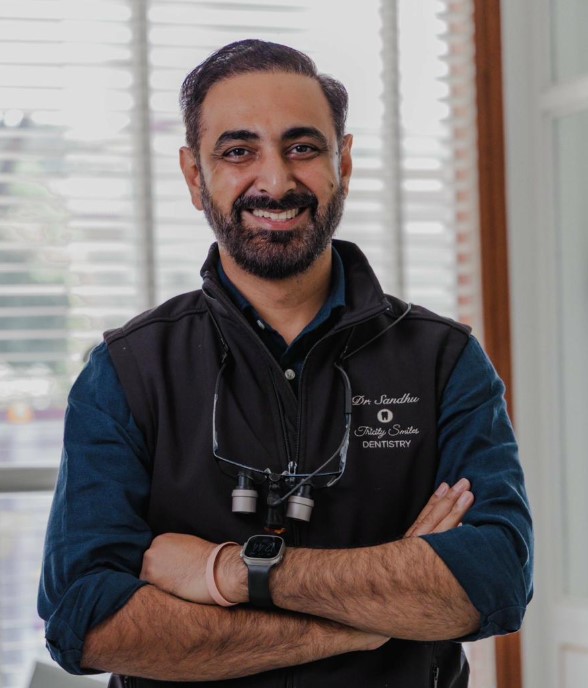
Dr. Sandhu
USC · UCSF · CMC Ludhiana
Your implant journey at Tricity Smiles
A clear, predictable process from first scan to final crown — no surprises, no jargon.
01
3D Imaging & Treatment Planning
3D imaging maps bone volume, density, nerve location, and sinus proximity. A personalised treatment plan with fully transparent pricing — including implant, crown, and any grafting required — is agreed before any procedure begins.
02
Implant Placement (~60 min)
Under local anaesthesia, the BioHorizons implant is placed into the prepared bone site. A healing cap is placed and the gum sutured. Most patients are comfortable the same day with standard pain relief.
03
Osseointegration (3–4 months)
The implant fuses with the surrounding bone. You carry on normally during this period. A check-up confirms full integration before proceeding to the crown stage.
04
Digital Scan & Crown Delivery
A scan body is seated and a digital intraoral scan taken. Your ceramic crown is milled to the exact implant position and fitted at a final appointment — radiographically verified before you leave.
Start with a consultation
Know exactly what is possible before committing to anything. Your imaging, your plan, your price — all agreed at the first appointment.
— What to Ask Before Saying Yes
The questions every implant patient should ask their dentist
Will you take 3D imaging before placing the implant?
Do you use a scan body and titanium base for the crown?
Will you take an X-ray to verify the crown is fully seated?
Which implant brand and system are you using?
What crown material will be used, and which lab makes it?
Are all costs itemised separately — implant, crown, and grafting?
At Tricity Smiles, the answer to every question on this list is yes — as standard, not as an upgrade. Every implant case begins with 3D imaging. Every crown is made through a digital workflow using BioHorizons-compatible scan bodies and titanium base abutments. Every cost — implant, crown, and grafting if required — is agreed in writing before any procedure begins.
This is the standard of care that patients in the United States expect and receive — and the standard we maintain in Chandigarh. An implant is the closest thing dentistry can offer to a natural tooth. But only if it is planned carefully, executed precisely, and crowned with the same attention. That is the only way we do it here.
— FAQ
Dental implant FAQs
Common questions about implants in Chandigarh — answered clearly, without jargon.
How much do dental implants cost in Chandigarh?
Implant costs depend on the number of implants, bone health and the type of crown. You’ll receive a written, itemised quote after your consultation. The crown cost depends on the material selected and the lab used. If bone grafting or a sinus lift is required, those costs are also agreed separately before treatment begins. There are no hidden charges and nothing is added after you have committed.
Why does the implant brand matter?
The implant brand determines long-term success. BioHorizons implants are FDA-cleared, US-manufactured, and backed by decades of peer-reviewed research showing 97%+ long-term survival rates. Cheaper generic implants use lower-grade titanium, lack independent clinical data, and are often incompatible with digital crown workflows. An implant is permanent. The brand matters for the rest of your life.
Why is 3D imaging mandatory before every implant?
3D imaging gives a full map of your jaw — bone height, width, density, and the exact position of the inferior alveolar nerve and maxillary sinus. Without this, implant placement involves guesswork that can result in nerve damage, sinus perforation, or failure. At Tricity Smiles, 3D imaging is required for every implant patient as a non-negotiable clinical standard — not an optional extra.
Who is a good candidate for dental implants?
What is a scan body and how does the crown get made?
After the implant has healed, a BioHorizons-compatible scan body is placed on it and our intraoral scanner records the exact 3D position of the implant in the mouth. This data is used to design and fabricate the crown — which is made on a titanium base abutment, a precision-milled component that connects the ceramic crown to the implant with a secure, biocompatible interface. Crown cost is discussed and agreed separately during treatment planning.
How long does the full implant process take?
The implant is placed in approximately 60 minutes under local anaesthesia. A healing period of 3–4 months follows for osseointegration. After healing, a digital scan is taken and the crown delivered within 2–3 weeks. Total timeline: approximately 4–6 months from placement to final crown.
Is implant placement painful?
The procedure is performed under local anaesthesia and most patients describe it as comparable to a tooth extraction. Electronically controlled anaesthetic delivery makes injections virtually painless. Mild soreness for 2–3 days post-surgery is normal and managed with standard pain relief. Nitrous oxide sedation is available for anxious patients.
For Patients — Share This Link
After your implant is placed
What to expect and how to protect your implant during healing.
First 24 Hours
- Bite gently on gauze for 30–60 minutes to control bleeding
- Avoid hot food and drink for the rest of the day
- Do not rinse vigorously — allow the clot to stabilise
- Do not smoke — smoking significantly increases the risk of implant failure
First Week
- Take prescribed antibiotics and pain relief as directed
- Rinse gently with warm salt water from day 2 onwards
- Eat soft foods — avoid chewing on the implant side
- Avoid strenuous exercise for 48–72 hours
During Healing (3–4 months)
- Maintain good oral hygiene around the healing cap
- Attend your check-up to confirm osseointegration
- Do not disturb the healing cap or probe the site
Related reading: Dental implants: safety guide
A permanent tooth that lasts a lifetime.
Start with a consultation. Know your bone, know your plan, know your price — all before a single procedure begins.
5★
Google Rating
5-star
rated on Google
20+
Years Experience