
Kids Root Canal
in Chandigarh
— Saving Baby Teeth Gently & Pain-Free
45–60 min
Local
- ★★★★★ 5-star rated on Google
- Verified reviews on Google
- Read Reviews →
— Why Baby Teeth Get Infected
Baby teeth need root canal treatment? Here’s why it happens.
Almost every parent who hears their child needs a baby root canal says the same thing: “Can’t we just pull it out? It’s going to fall out anyway.” It’s a reasonable question. Baby teeth are temporary. Why go through a procedure to save one? The answer is that an infected baby tooth doesn’t stay quietly infected. It hurts. It can develop an abscess. It can spread infection to the permanent tooth developing beneath it. And losing a baby molar too early — before the permanent tooth is ready to come through — triggers a chain of orthodontic consequences that take years to fix.
Extracting an infected baby tooth solves the immediate problem. It doesn’t solve what comes next. Adjacent teeth drift into the gap. The permanent successor may erupt at the wrong angle. The child may need a space maintainer to preserve the arch. In most cases, treating the tooth and keeping it until it falls out naturally is the better clinical and orthodontic outcome.
Decay in children progresses faster than in adults. Baby tooth enamel is thinner, the pulp chamber is proportionally larger, and the distance from the surface to the nerve is shorter. A cavity that would take years to reach the nerve in an adult tooth can reach the pulp in a baby tooth within months. By the time a child is in pain — or a parent notices a swollen gum or a tooth that has gone grey — the infection is usually well established. Dr. Sandhu will assess the extent with a periapical X-ray before recommending pulpotomy or pulpectomy.
- Toothache that wakes the child at night
- Swelling of the gum near a tooth
- A pimple or bump on the gum (sinus tract)
- A tooth that has darkened or gone grey
- Child refusing to eat on one side
- Face or cheek swelling (SEEK CARE TODAY)
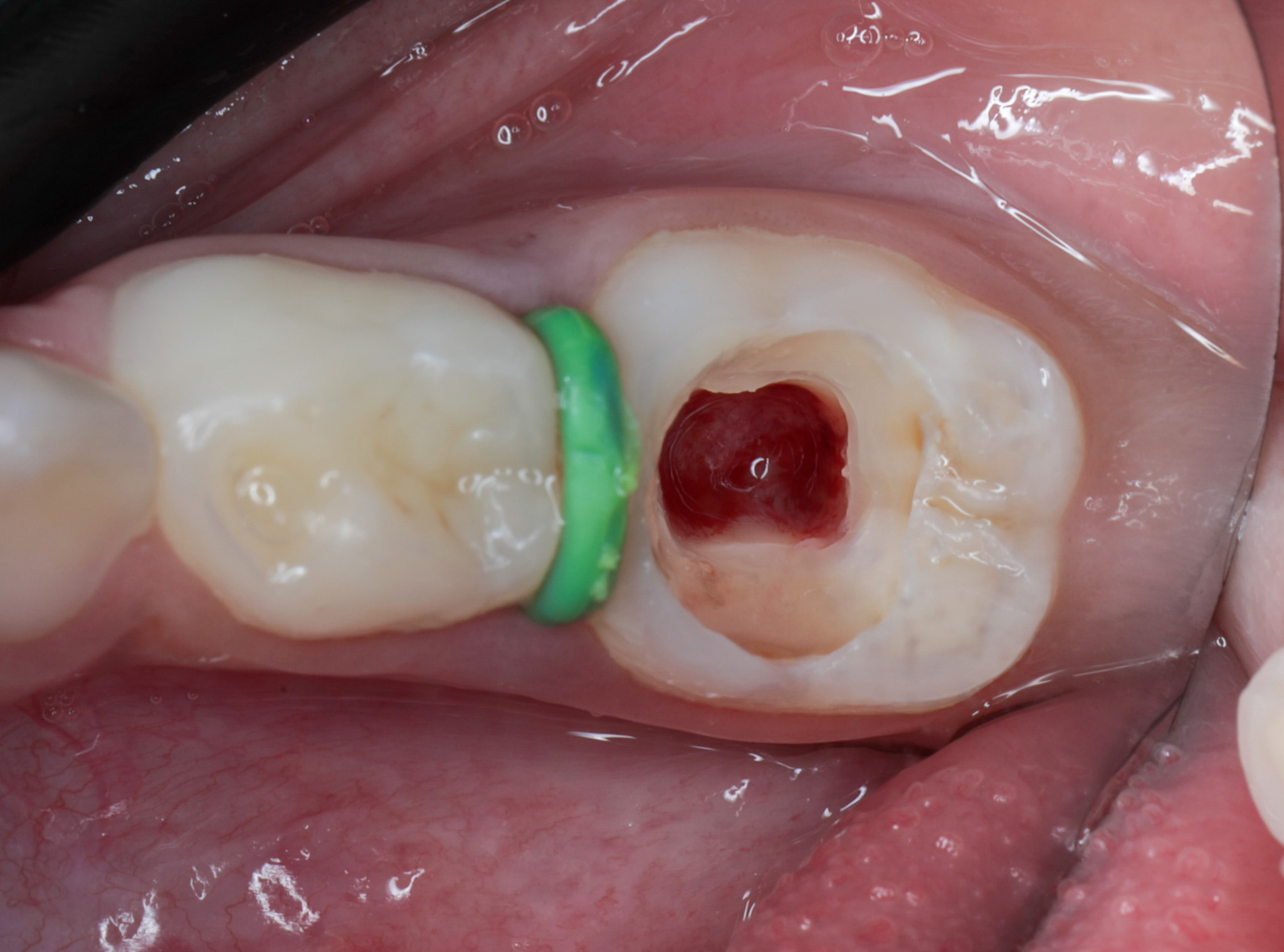
Pulpotomy or pulpectomy — what’s the difference?
Pulpotomy Baby Root Canal · Partial | Pulpectomy Kids RCT · Full | |
|---|---|---|
| Also called | Baby root canal, partial pulp therapy, tooth nerve treatment kids | Full pulp therapy, kids RCT, pulpectomy |
| What it treats | Infection limited to the crown portion of the pulp — root tissue is still healthy on X-ray | Infection that has spread into the root canals — deeper and more extensive |
| What is removed | Infected pulp in the crown portion only. Root canal tissue left intact and healthy. | All pulp tissue from both the crown and the full length of the root canals |
| What is placed | Medicated dressing (MTA or Biodentine) to preserve remaining healthy root tissue | Resorbable paste fills the root canals — critical for allowing the permanent tooth to erupt normally |
| Why resorbable material matters | — | Baby tooth roots must dissolve naturally as the permanent tooth erupts. Adult RCT materials cannot be used here — they would block this process. |
| Duration | 45–60 min including crown | 60 min including crown |
| Crown required? | Yes — placed same appointment in most cases | Yes — placed same appointment in most cases |
| Starting price | ₹5,000+ (crown priced separately) | Higher — confirmed at examination (crown priced separately) |
The decision between pulpotomy, pulpectomy, and extraction
Factor 1 — The X-Ray
What the Radiograph Shows Changes Everything
A periapical X-ray is the foundation of every pulp therapy decision at Tricity Smiles. It shows the extent of decay, whether infection has reached the root canals, whether there is bone loss around the root, and whether the permanent tooth developing beneath is at risk. A tooth with intact root structure and no periapical pathology is a candidate for pulpotomy. Furcation involvement, widened periodontal ligament space, or internal root resorption shifts the decision to pulpectomy — or, in some cases, to extraction.
Factor 2 — Save or Extract?
When Saving the Tooth Is Worth It — and When It Isn’t
Not every infected baby tooth should be saved. If the tooth has lost too much root structure, if infection has destroyed the supporting bone, or if the permanent tooth is close to erupting, extraction may be the more appropriate option. Dr. Sandhu makes this assessment at the examination and explains the reasoning. Where a tooth can and should be saved, the evidence supports saving it. Where it cannot, the recommendation is extraction — and a space maintainer discussion follows.
A Crown Is Required. Planned Before the Procedure Begins.
A tooth that has undergone pulp therapy is structurally compromised. A filling alone is not sufficient. An SSC or esthetic is placed in the same appointment in most cases — protecting the tooth immediately and eliminating a second visit. At Tricity Smiles, the crown is planned before the pulp therapy begins, not as an afterthought at the end. The two procedures are treated as one appointment.
Pain Management & Medication
Pain during and after — and what we prescribe, and why
Kids root canal treatment at Tricity Smiles is performed under local anaesthesia. Your child will feel pressure and movement, but should feel no pain during the procedure. Nitrous oxide (laughing gas) is available for anxious children and is particularly helpful for procedures of this length. Dr. Sandhu uses a tell-show-do approach throughout — every step explained to the child before it happens.
Antibiotics are not a routine part of pulp therapy. They do not replace proper drainage and pulp treatment — a tooth that needs a pulpectomy needs a pulpectomy, not a prescription. When antibiotics are prescribed at Tricity Smiles, the antibiotic, dose, and duration are selected based on your child’s weight, not a generic adult protocol.
Many parents arrive having been told that antibiotics resolved a dental infection. They may have temporarily suppressed the symptoms — but the bacteria inside the pulp remain. The tooth will re-infect. The only definitive treatment is removing the infected tissue. Dr. Sandhu will explain this clearly, without judgement and without rushing.
Local Anaesthesia — Your Child Should Feel No Pain
The tooth and surrounding tissue are fully numb before any work begins. Pressure and vibration are normal sensations — pain is not. Nitrous oxide can be added for any child who needs additional support.
After the Procedure
Mild Soreness for 24–48 Hours Is Normal
Tenderness when biting is expected and managed with paracetamol or ibuprofen. Before your child leaves, Dr. Sandhu provides written dosing instructions based on your child’s current weight.
ⓘ Never estimate weight-based dosing from adult packaging. Written instructions specific to your child’s weight are provided at every appointment.
Antibiotics
Prescribed on Clinical Grounds — Not Routinely
Antibiotics are prescribed only when infection has spread beyond the tooth: facial swelling, lymph node involvement, or systemic signs. When prescribed, the choice, dose, and duration are weight-based and written down before you leave.
— Why Tricity Smiles
Root canal treatment for children in Chandigarh — done by someone trained to know the difference
US-Trained in Paediatric Endodontics
Periapical X-Ray Before Every Pulp Therapy Decision
Pain Management and Prescriptions Written for Your Child’s Weight
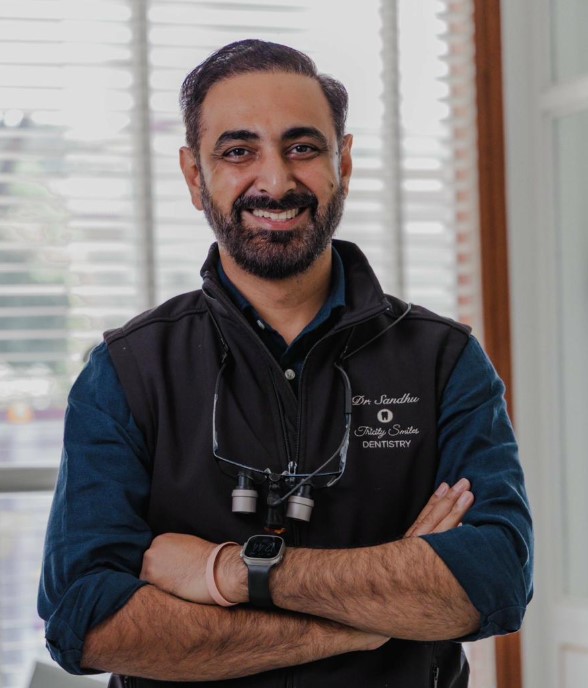
Dr. Sandhu
USC · UCSF · CMC Ludhiana

Your child is in pain. Let’s fix that.
5★
Google Rating
5-star
rated on Google
20+
Years Experience
— Our Philosophy
The tooth that needed a root canal last week
needed a filling last year.
“We do not say this to make parents feel guilty. We say it because the same sequence is happening right now in other teeth — and those teeth can still be caught at the filling stage.”
— Dr. Sandhu
What we try to do at Tricity Smiles is interrupt the sequence before it completes. That is what the caries risk assessment is for. That is what the fluoride treatment and the sealants are for. And that is why we treat the appointment after the pulpotomy as equally important as the pulpotomy itself — because it is the moment when the family’s relationship with preventive dentistry either begins or doesn’t.
The child who comes in every six months already knows the room, knows the chair, and knows that most appointments are short and easy. When a more complex appointment does come, it does not feel like a first encounter with dentistry. That familiarity is worth building early.
What parents ask us about kids root canal treatment
Is a baby root canal really necessary, or can the tooth just be extracted?
What is the difference between a pulpotomy and a pulpectomy?
How much does a baby root canal cost in Chandigarh?
Will my child be in pain during the procedure?
What pain relief do I give my child afterwards?
Does my child need antibiotics after a baby root canal?
Antibiotics took the pain away. Do we still need to treat the tooth?
Can this be prevented in future teeth?
What to expect in the first 48 hours
- Mild soreness when biting — normal for 24–48 hrs
- Slight gum tenderness around the treated tooth
- Child quieter than usual — this passes by the next day
Do
- Soft foods for 24 hours
- Paracetamol or ibuprofen — use the written weight-based dose given at discharge
- Normal brushing, gently around the treated tooth
- Complete any antibiotics prescribed — full course, even if child seems better
- Sticky or hard foods on the treated side for 24 hours
- Adult doses of pain relief
- Stopping antibiotics early if prescribed
- Swelling develops or gets worse
- Child develops a fever
- Pain is severe and not responding to the correct dose
- Crown becomes loose or falls off
Related reading: Root canal in baby teeth
Treat the tooth that hurts. Then prevent the next one.
Dr. Sandhu will assess the tooth, explain exactly what is needed, and give you a written treatment plan before anything begins. Book the prevention appointment alongside it — the two belong together.
5★
Google Rating
5-star
rated on Google
20+
Years Experience