
TMJ Stabilisation Splint
in Chandigarh — Expert Jaw Pain Relief with Dr. Sandhu
A hard acrylic stabilisation splint designed to decompress the jaw joint, reduce muscle overload, and resolve the pain, clicking, and restricted movement that come with temporomandibular joint dysfunction.
Appliance Type
Hard Acrylic
worn
Nightly
- ★★★★★ 5-star rated on Google
- Verified reviews on Google
- Read Reviews →
— Understanding the Condition
What is TMJ dysfunction — and why does it cause so many symptoms?
The temporomandibular joint — the TMJ — is the hinge joint connecting the lower jaw to the skull. It is one of the most complex joints in the body: it both rotates and translates with every jaw movement, and it is involved in every bite, every chew, every swallow, and every word spoken.
Temporomandibular dysfunction, or TMD, is a broad term for a range of problems affecting this joint and the muscles that control it. The causes are often multifactorial — parafunctional habits like clenching and grinding, a bite that loads the joint unevenly, stress, joint anatomy, and prior trauma can all contribute. In many patients, several of these factors are present simultaneously.
Because the TMJ sits at the junction of the jaw, ear, and skull base, dysfunction in the joint produces symptoms that patients often do not immediately associate with their teeth or bite. Ear fullness, temple headaches, neck tension, and facial pain are all common presentations of TMD — and all can be meaningfully reduced by removing the forces that are overloading the joint.
That is what a stabilisation splint is designed to do.

Symptoms that suggest TMJ dysfunction
TMD presents differently in different patients. These are the most common signs — and the ones a stabilisation splint is designed to address.
01
Jaw Pain or Soreness
Aching or soreness in the jaw joint itself, in front of the ear, or in the jaw muscles — particularly on waking. This is the most direct sign of joint and muscle overload from clenching or grinding during sleep.
02
Clicking or Popping in the Joint
An audible or palpable click, pop, or grating sensation when opening or closing the mouth. Clicking indicates displacement of the articular disc within the joint — a structural change that often accompanies chronic muscle overloading.
03
Limited or Deviated Mouth Opening
Difficulty opening the mouth fully, or a jaw that deviates to one side on opening, indicates uneven muscle pull or restricted joint movement. In more severe cases, the jaw may catch or momentarily lock on opening.
04
Temple Headaches on Waking
The temporalis muscle — which runs over the temple — is one of the primary jaw-closing muscles. Chronic clenching keeps it in sustained contraction, producing tension headaches that are typically worst in the morning and improve through the day.
05
Ear Fullness or Facial Pain
Because the TMJ sits immediately adjacent to the ear canal, joint inflammation can cause referred ear pain, a feeling of fullness or pressure in the ear, and facial pain below the cheekbone. These are frequently misattributed to ear or sinus problems.
06
Neck and Shoulder Tension
The masticatory muscles are continuous with the neck and shoulder musculature. Chronic jaw muscle overactivity — particularly the pterygoids — produces referred tension in the neck and upper shoulders that does not resolve with massage or stretching alone.
Not all of these symptoms need to be present. Some patients present with only jaw clicking and no pain. Others have significant headaches but minimal joint symptoms. A clinical assessment maps your specific symptom pattern to determine the appropriate treatment.
— How the Splint Works
What a stabilisation splint actually does
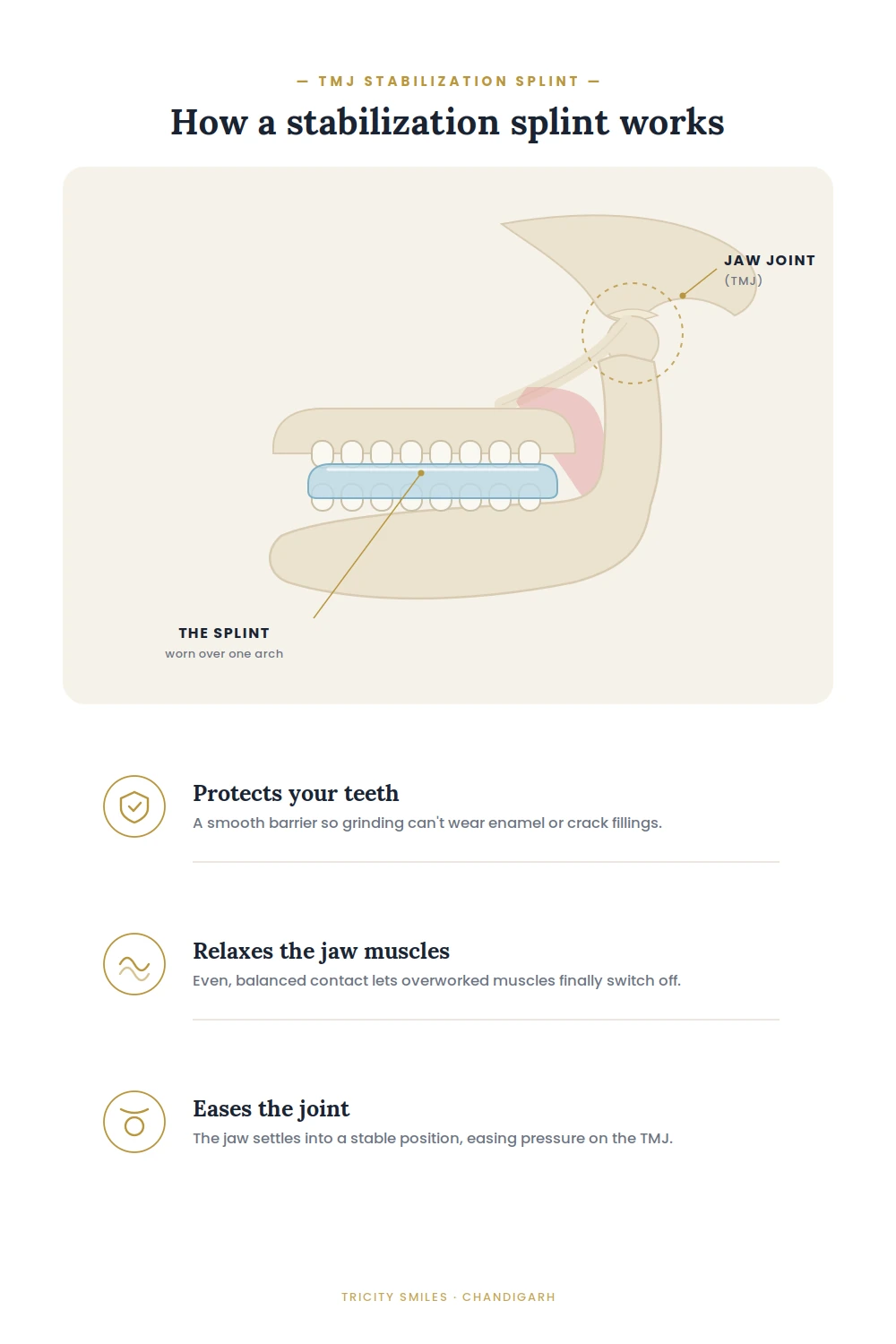
A stabilisation splint is not just a plastic guard that sits between the teeth. It is a precisely designed occlusal appliance that changes the forces acting on the jaw joint and the muscles that load it. The design is what makes it therapeutic — not the material alone.
Decompresses the Temporomandibular Joint
Creates an Ideal Occlusal Surface
Anterior Guidance and Canine Rise
Allows Muscles to Decompress
From assessment to fitted splint
01
Clinical Assessment
A thorough examination of the jaw joints, muscles, range of motion, and occlusion. Symptom history, jaw deviation on opening, muscle tenderness points, and joint sounds are all documented. This determines whether a splint is indicated and what design is appropriate.
02
3D Intraoral Scan
A digital scan of the upper and lower teeth is taken — no impression trays or putty. Precise digital models are used to fabricate the splint to the exact dimensions and contours of your dentition.
03
Splint Fabrication
A hard acrylic splint is fabricated over printed models. The occlusal surface is designed to the correct therapeutic scheme — even contacts, anterior guidance, and canine rise. Not a generic flat-plane guard.
04
Fitting, Adjustment & Review
The splint is seated and occlusal contacts verified with articulating paper. Adjustments are made at the chair. A follow-up review is scheduled at 4–6 weeks to assess the clinical response and refine the appliance if needed.
TMJ splint vs. night guard
Patients often ask whether a night guard will do the same job. It will not — and using a soft guard when a stabilisation splint is indicated can delay recovery. Here is why.
Recommended Exercises
TMJ exercises we recommend alongside your splint
A stabilisation splint manages the forces acting on the joint at night. These exercises help reduce muscle tension, restore coordinated jaw movement, and reinforce recovery during the day. They take less than five minutes and should be done gently — never to the point of pain.
Before You Begin — Warm Compress
Apply heat for 5–10 minutes before any jaw exercise
Warm therapy before exercising is not optional — it is the step that makes everything else more effective. Heat increases blood flow to the masticatory muscles, reduces muscle viscosity, and lowers the activation threshold so the muscles respond to gentle movement rather than resisting it. Exercising cold, tense muscles produces minimal benefit and risks aggravating an already irritated joint.
How: Soak a facecloth in warm (not hot) water, wring it out, and hold it firmly against the jaw joint and masseter — just in front of the ear and along the jaw angle — for 5–10 minutes. A reusable heat pack or warm wheat bag works equally well. The temperature should feel comfortably warm, never burning.
When: Ideally in the morning, when the muscles are at their most tense from overnight clenching. Do the warm compress first, then proceed through the exercises while the muscles are still warm and relaxed.
Muscle Relaxation
Resting Position Exercise
The correct resting position of the jaw is teeth slightly apart, lips lightly closed, and the tongue resting gently on the palate just behind the upper front teeth. Most people with TMD habitually hold their teeth together or clench during the day without noticing.
How: Consciously bring your tongue to rest on the palate, allow the jaw to drop slightly, and let the teeth separate by 1–2mm.
When: Practise throughout the day whenever you notice yourself clenching. Set a phone reminder every hour if needed.
Goal: Make the teeth-apart resting position automatic. Daytime clenching undoes much of what the splint achieves at night.
Guided Jaw Opening
Patients with TMD often open unevenly — the jaw deviates to one side as the muscles on the more restricted side pull it off a straight path. This exercise retrains coordinated bilateral opening.
How: Place the tip of your tongue on the palate behind the upper front teeth. Keeping it there, slowly open your mouth as far as is comfortable without the tongue leaving the palate. The tongue position limits over-opening and encourages the joint to translate correctly.
Reps: 10 slow repetitions, twice daily.
Watch for:Deviation to one side. If the jaw consistently pulls left or right, bring it back to centre slowly and hold for two seconds at mid-opening.
Resisted Opening
Resisted opening strengthens the muscles that open the jaw — the digastric and lateral pterygoid — which are often inhibited or uncoordinated in TMD patients. It also improves proprioception of jaw position.
How: Place your thumb under your chin. Open your mouth slowly against the gentle resistance of your thumb. Hold at maximum comfortable opening for 3–5 seconds, then close slowly.
Caution: 6–10 repetitions, once daily.
Reps: Only gentle resistance. This is not a strength exercise — it is a coordination exercise. Stop immediately if it produces sharp joint pain.
Masseter Self-Massage
The masseter — the large jaw-closing muscle you can feel bulging when you clench — is almost always hypertonic in bruxers and TMD patients. Releasing it directly reduces referred pain to the teeth, jaw, and temple.
How: Place two or three fingertips on the masseter (the muscle bulk below the cheekbone and in front of the ear). Apply gentle, sustained pressure to the tightest point you can find. Hold for 30–60 seconds until the tension softens, then release slowly.
When: Morning and evening, 2–3 minutes each side.
Tip: Warmth before massage — a warm facecloth held against the muscle for a minute — significantly improves the release.
Postural
Chin Tuck
Forward head posture — a chin that juts forward — increases the load on the posterior jaw muscles and can contribute to TMD symptoms. The chin tuck counteracts this by restoring the natural cervical curve and reducing muscle tension in the jaw-neck complex.
How:Sitting or standing upright, gently draw the chin straight back — not down — as if making a double chin. Hold for 5 seconds. Release. The back of the neck should feel gently stretched.
Reps:10 repetitions, 2–3 times daily.
Why it matters: For every centimetre the head moves forward of the spine, the effective load on the cervical muscles doubles. This directly increases the tension in the jaw-closing muscles.
Stretching
Lateral Pterygoid Stretch
The lateral pterygoid is a deep muscle that protrudes the jaw and opens the joint. In TMD patients it is frequently in spasm, contributing to the anterior displacement of the disc and restricted opening.
How: Open the mouth slightly. Place your index finger on the lower front teeth and apply very gentle downward pressure while resisting with the jaw (partial resistance — not maximum force). Hold 5 seconds, release. Then let the jaw rest open for 10 seconds.
Reps:5 repetitions, once daily.
Caution:This exercise targets a deep muscle. Gentle pressure only. If it produces clicking or sharp pain, stop and report at your next appointment.
Important: These exercises are general recommendations for patients with mild to moderate TMD managed with a stabilisation splint. They are not a substitute for a clinical assessment. If any exercise worsens your symptoms or causes sharp joint pain, stop and let us know at your next appointment. Patients with locking, severe opening restriction, or acute joint pain should seek clinical review before beginning exercises.
— What Makes a Splint Therapeutic
The design is the treatment. Not just the appliance.
Clinical assessment before fabrication
Even bilateral contacts verified with articulating paper
Anterior guidance designed into the occlusal surface
Hard acrylic — not soft material
Follow-up review included
Honest assessment of what a splint can and cannot achieve
The splint costs ₹15,000. Unmanaged TMD costs considerably more — in dental restorations worn through by bruxism, in investigations for ear or sinus problems that are actually jaw-related, and in years of manageable pain that was never properly addressed.
Jaw pain that gets worse is jaw damage accumulating
Book a consultation to find out if it is right for you.
— FAQ
TMJ splint FAQs
Common questions about TMJ dysfunction, stabilisation splints, and how they differ from night guards.
How much does a TMJ splint cost in Chandigarh?
What is a TMJ stabilisation splint and how does it work?
What are the symptoms of TMJ dysfunction?
What is the difference between a TMJ splint and a night guard?
How long does it take for a TMJ splint to work?
Can a TMJ splint be worn during the day?
Care & Use Guide
How to wear and maintain your splint
- Wear every night — consistency is essential for the treatment to work
- Seat it fully by pressing with your fingers — all teeth should contact the splint surface
- It should feel snug and stable. If it rocks, feels loose, or causes soreness, contact us for an adjustment
- Some patients feel slight tooth tenderness in the first few days as the muscles begin to decompress — this is normal and settles
- Rinse with cold water immediately after removing each morning
- Clean with a soft toothbrush and mild liquid soap — rinse thoroughly
- Soak weekly in a diluted denture cleaning solution to prevent bacterial build-up
- Never use toothpaste — abrasive and will scratch the acrylic surface
- Never use hot water — will distort the acrylic
- Store in its vented case — dry, clean, and away from heat
- Attend your follow-up review — contacts on hard acrylic can shift with wear and need periodic checking
- Contact us if symptoms worsen after starting wear — the splint may need adjustment
Related reading: Night guards for teeth grinding
Your jaw should not hurt every morning.
A stabilisation splint is the evidence-based first-line treatment for TMJ dysfunction. Most patients feel a meaningful difference within weeks.
5★
Google Rating
5-star
rated on Google
20+
Years Experience