
Paediatric Esthetic Dentistry
Kids Esthetic Crowns in
Chandigarh
— Natural-Looking Crowns for Baby Teeth
When parents want a tooth-coloured crown for their child, the choice isn’t just silver or white — it’s which white crown suits this tooth. Dr. Sandhu selects between BioFlx and zirconia based on the tooth’s position, function, and your child’s clinical picture.
Duration
30–45 min
Pain Level
Minimal
- ★★★★★ 5-star rated on Google
- Verified reviews on Google
- Read Reviews →
— Why “No Silver” Is the Right Question
Your child needs a crown. You’ve asked for a tooth-coloured option. Here’s what that actually means.
Most parents who come to Tricity Smiles asking for a white crown for their child — a kids crown with no silver — arrive having already made the right decision. Avoiding a stainless steel crown when an esthetic alternative is clinically appropriate is a valid preference, and one Dr. Sandhu supports where the clinical situation allows. The next question, though, is the one most clinics don’t answer: which tooth-coloured crown, and why?
BioFlx and zirconia are both tooth-coloured, both metal-free, and both available at Tricity Smiles — but they are made from different materials, prepared differently, and suited to different clinical situations. A natural-looking crown on a baby tooth only delivers on its promise if the right material has been placed on the right tooth. The appearance of a poorly chosen crown degrades. A well-chosen one lasts until the tooth falls out naturally.
Dr. Sandhu trained at USC and UCSF, where paediatric esthetic restorations were part of the clinical curriculum. At Tricity Smiles, the choice between BioFlx and zirconia is made on clinical grounds: tooth position, bite forces, extent of decay, and how much preparation the tooth can accommodate. Both options are available. The right one is chosen for your child. A full comparison is in the table below.
100%
Front & back

All Three Options
White vs silver crown for a baby tooth — how all three compare
Stainless steel remains the strongest option and is included here for reference. Both tooth-coloured options — BioFlx and zirconia — are available at Tricity Smiles.
| Stainless Steel Crown (SSC) 3M — Silver | BioFlx Crown Tooth-Coloured · Flexible | Zirconia Crown Tooth-Coloured · Ceramic | |
|---|---|---|---|
| Material | Medical-grade stainless steel (3M) | Hybrid resin polymer — metal-free, Bis-GMA free, biocompatible. Flexible and self-adaptive. | Solid ceramic — metal-free. The most lifelike appearance available. |
| Appearance | Silver | Tooth-coloured | Tooth-coloured — the most natural-looking |
| Strength | Highest — the 60-year benchmark for back baby teeth | Very good — flexible under biting forces, self-adaptive fit | Good — strong but more brittle; better suited to front teeth |
| Best for | Back molars, high-decay-risk cases, Hall Technique candidates | Posterior teeth where esthetic preference exists; flexibility absorbs chewing forces well | Visible front teeth where appearance is the priority |
| Tooth preparation | Minimal (conventional) or none (Hall Technique) | Standard preparation required | More preparation than BioFlx — precise margins needed |
| Hall Technique compatible? | ✓ Yes | ✗ No | ✗ No |
| Clinical track record | Proven 60+ year history. Endorsed by the American Academy of Pediatric Dentistry. | 92–98% retention at 12 months in published clinical studies | Good — most evidence for anterior (front) teeth; technique-sensitive to place |
| Starting price | ₹5,000+ | ₹7,500+ — confirmed at consultation | ₹7,500+ — confirmed at consultation |
Esthetic Pediatric Crown Protocol
White vs silver crown for a baby tooth, the clinical decision behind the aesthetic one
Choosing a tooth-coloured crown involves three questions. Here is how we answer them at every appointment.
Question 1 — Which Tooth?
Position and Bite Forces Come First
Front (anterior) teeth and back (posterior) teeth face very different demands. Front teeth are visible but bear lighter forces — zirconia’s superior aesthetics make it the natural choice here. Back molars bear the full force of chewing — BioFlx’s flexibility gives it an advantage in absorbing these forces without fracture. Zirconia on a back molar in a child who bruxes carries a higher fracture risk. Dr. Sandhu maps the tooth to the material, not the other way around.
Question 2 — How Much Tooth Is Left?
Preparation Requirements Are Not the Same
Both BioFlx and zirconia require more tooth preparation than a stainless steel crown. Zirconia requires the most — precise preparation margins and adequate remaining structure to seat the crown correctly. BioFlx’s flexible nature gives it some tolerance for variation. Where remaining tooth structure is very limited after extensive decay, an SSC may still be the most clinically appropriate option even when aesthetics are preferred.
Question 3 — Is the Pulp Healthy?
Pulp Assessment Before Any Crown — Without Exception
A periapical X-ray and pulp assessment precede every esthetic crown at Tricity Smiles. If pulp involvement is found, a pulpotomy is completed in the same appointment before the crown is placed. No crown — esthetic or otherwise — is placed over an unaddressed infected pulp. This step is the single most important factor in how long any paediatric crown lasts.
— What to Expect
The esthetic crown appointment what happens for BioFlx and zirconia
Esthetic crown appointments at Tricity Smiles typically take 30 to 45 minutes. Unlike stainless steel crowns, neither BioFlx nor zirconia is compatible with the Hall Technique both require some tooth preparation under local anaesthesia. Dr. Sandhu explains exactly what is involved for your child’s specific tooth at the consultation, before any treatment is agreed.
Dr. Sandhu uses a tell-show-do approach at every paediatric appointment each step is described in age-appropriate language before it happens. Nitrous oxide is available for anxious children and can be added to any appointment.
01
Pulp Assessment & X-Ray
A periapical X-ray is taken to confirm pulp status. If pulp involvement is found, a pulpotomy is completed first — usually in the same appointment as the crown.
02
Local Anaesthesia & Tooth Preparation
The area is numbed. The tooth is prepared to the appropriate margins for the crown type — slightly more reduction for zirconia than BioFlx. Preparation is precise and conservative of remaining structure.
03
Crown Sizing, Try-In & Fit
The correct crown size is selected and tried on the prepared tooth. For BioFlx, fit and occlusion are assessed against the prepared tooth. For zirconia, seating is checked at the margins. Adjustments are made before cementation.
04
Cementation & Post-Insertion Check
The crown is cemented with the appropriate luting agent for the crown material. The bite is verified with articulating paper and a post-insertion X-ray confirms complete seating. The parent is shown the X-ray before leaving.
— Why Tricity Smiles
Esthetic paediatric dentistry in Chandigarh — where material choice is clinical, not cosmetic
US-Trained in Paediatric Esthetic Restorations
Two Esthetic Options — One Chosen on Clinical Grounds
Correct Cementation for Each Crown Type
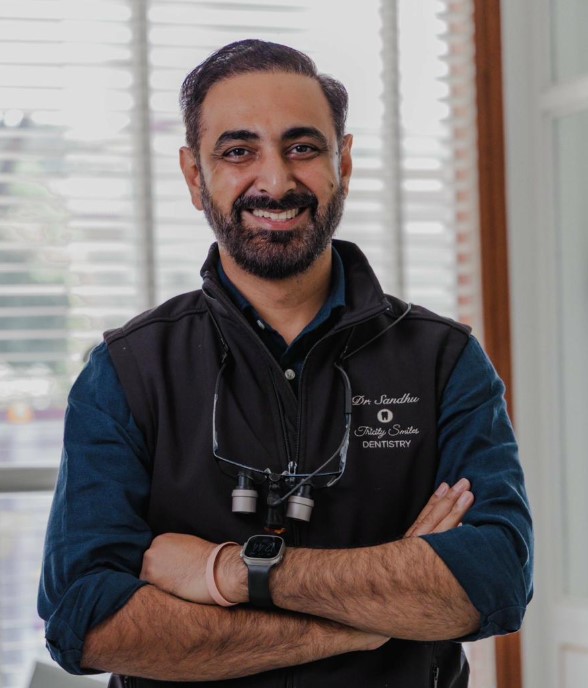
Dr. Sandhu
USC · UCSF · CMC Ludhiana
Want a tooth-coloured crown for your child?
Dr. Sandhu will assess the tooth, confirm which esthetic option is appropriate, and give you a written plan before anything begins.
5★
Google Rating
5-star
rated on Google
20+
Years Experience
— Our Philosophy
The crown that looks right is the one placed on the right tooth.
Esthetic paediatric crowns are not a premium tier of treatment — they are a clinically appropriate choice for specific teeth in specific situations. The mistake is treating them as an automatic upgrade for any child whose parent would prefer no silver. A BioFlx crown on a heavily loaded back molar in a child who grinds is a restoration that may fail before the tooth does. That outcome does not serve the child, regardless of what it looks like.
“The right crown for your child’s tooth is not always the most expensive one. It is the one that will still be there when the tooth is ready to fall out.”
— Dr. Sandhu
What we offer at Tricity Smiles is a decision, not a product. Parents who come asking for a white crown leave with an explanation of which white crown suits their child’s tooth and why — or, where an SSC is genuinely the better clinical choice, an honest conversation about that.
A cosmetic kids dentist who places the same esthetic crown on every tooth regardless of position or function is not serving the child. We do not operate that way. The material is chosen for the tooth. The tooth is the starting point — not the parent’s preference, and not what is most convenient to place.
— Questions & After-Care
What parents ask us about kids esthetic crowns
Common questions about BioFlx crowns, zirconia crowns, and tooth-coloured options for baby teeth in Chandigarh.
What is the difference between a BioFlx crown and a zirconia crown for kids?
Both are tooth-coloured and metal-free. BioFlx is made from a flexible hybrid resin polymer — self-adaptive, absorbs biting forces well, and suits posterior (back) teeth where flexibility under load is an advantage. Zirconia is a solid ceramic — harder, more rigid, and the most lifelike in appearance, making it the preferred choice for visible front teeth. The right choice depends on which tooth is being treated and the clinical picture.
Is a white crown as strong as a silver crown?
How much do kids esthetic crowns cost in Chandigarh?
Do you offer NuSmile crowns in Chandigarh?
We do not use NuSmile at Tricity Smiles. We use BioFlx (a flexible hybrid resin polymer crown) and zirconia ceramic crowns — both tooth-coloured, metal-free options. If you have researched NuSmile specifically, BioFlx is a direct equivalent in the same clinical category. Dr. Sandhu will explain the differences at the consultation.
Can an esthetic crown be placed on a back molar?
Yes — BioFlx is specifically suited to posterior (back) baby teeth where some esthetic preference exists. Its flexibility makes it more forgiving of biting forces than zirconia on a back tooth. Zirconia on a back molar carries a higher fracture risk, particularly in children who grind. Dr. Sandhu will assess which option is appropriate for the specific tooth at the examination appointment.
Does my child need a pulpotomy before the crown?
My child is anxious. How do you manage nervous children?
After Your Child’s Crown Appointment
What to do in the first 24 hours
Simple steps to protect the crown and keep your child comfortable.
Do
- Soft foods for the rest of the day
- Normal brushing resumes the same evening — gently around the crown
- Children’s paracetamol or ibuprofen if there is any soreness
- Call us if the bite feels high once the anaesthetic wears off
Avoid
- Sticky foods (toffee, chewing gum) — can dislodge the crown in the first 24 hours
- Hard foods on that side for the rest of the day
- Biting on the area before anaesthesia wears off
Watch For — Call Us
- Crown comes loose or falls off
- Swelling or pain more than 48 hours after the appointment
- Child cannot bite together comfortably after 24 hours
Related reading: Broken teeth in kids · How steel crowns save baby teeth
A crown that looks right — because it was chosen right.
Dr. Sandhu will examine the tooth, explain which esthetic option suits it, and give you a written plan before any treatment begins. If an SSC is the better clinical call, you’ll hear that too.
5★
Google Rating
5-star
rated on Google
20+
Years Experience