
Removable Prosthodontics
3D Printed Partial Dentures
in Chandigarh — Lighter, Better-Fitting, Made In-Clinic
Starting From
₹30,000+
Visits
Multiple
Pain Level
Minimal
Cost depends on the type of denture (Valplast or metal framework) and the number of teeth being replaced. All costs are agreed before treatment begins — no hidden charges.
- ★★★★★ 5-star rated on Google
- Verified reviews on Google
- Read Reviews →
— Understanding the Procedure
What is a partial denture?
A partial denture is a removable prosthesis that replaces multiple missing teeth in a jaw where some natural teeth remain. It attaches to those remaining teeth using precision clasps or flexible gum-coloured retainers, restoring your ability to chew, preventing the remaining teeth from drifting into the gaps, and maintaining the facial muscle support that collapses when multiple teeth are lost.
Unlike a fixed bridge or implants, a partial denture is removable — taken out at night for cleaning. For many patients, it is the most practical and cost-effective route to restoring function across a large area of missing teeth, particularly when the remaining teeth are not strong enough to support a fixed bridge, or when the extent of tooth loss makes implants an extensive undertaking.
At Tricity Smiles, Dr. Sandhu assesses every case individually — reviewing the remaining teeth, bone, bite, and the patient’s long-term goals — before recommending a denture type, material, and design.

Valplast flexible or metal framework?
We offer two types of partial denture — each with distinct advantages depending on the clinical situation. Neither is universally better. The right choice depends on your specific case.
Flexible Nylon
Valplast Flexible Denture
Valplast is a thermoplastic nylon material that flexes with the soft tissue, creating a denture that is lighter, more comfortable, and visually discreet — with gum-coloured clasps instead of metal wire.
- Clasps Gum-coloured nylon — nearly invisible
- Rigidity Flexible — adapts to soft tissue movement
- Weight Very light
- Aesthetics Excellent — no visible metal
- Metal allergy Fully metal-free
- Relines Cannot be relined as tissue changes
- Longevity 5–8 years with good care
Cast Framework
Metal Framework Denture
A cobalt-chrome metal framework denture has a rigid, precision-cast base that is thinner, stronger, and more stable under occlusal load than a flexible alternative — particularly for larger spans.
- Clasps Precision cast metal rests and clasps
- Rigidity Rigid — highly stable under biting forces
- Weight Slightly heavier but more stable
- Aesthetics Good — clasps visible on back teeth only
- Thickness Thinner base — more comfortable on palate
- Relines Can be relined as tissue changes
- Longevity 10–15+ years with good care
Why we do not offer acrylic partial dentures
Standard acrylic partial dentures — the pink plastic variety — are the most common and least satisfactory option. They are bulky, prone to fracture, place damaging stress on remaining teeth through poorly designed clasps, and accelerate the bone loss they are meant to compensate for. At Tricity Smiles, we offer Valplast and metal framework only — materials and designs that are clinically appropriate and built to last.
What to expect across your appointments
01
Assessment & 3D Scan
A comprehensive review of the remaining teeth, gum tissue, bone, bite, and facial profile. A 3Shape 3D intraoral scan replaces traditional impression trays entirely — capturing the arch, remaining teeth, and soft tissue contours digitally, without material in the mouth. Bite registration is recorded at this appointment.
02
Framework or Wax Try-In
For metal framework dentures, the cast framework is tried in to verify fit, extension, and clasp positioning before the teeth are added. For Valplast dentures, a wax try-in with the replacement teeth in position allows assessment of aesthetics, bite, and lip support before the final denture is processed.
03
Final Delivery & Fit
The finished denture is inserted and assessed thoroughly — stability, retention, occlusion on both sides, contact with adjacent teeth, and soft tissue adaptation. Adjustments are made chairside. You are shown how to insert, remove, and clean the denture correctly before leaving.
04
Follow-Up & Review
A follow-up appointment within 1–2 weeks addresses any pressure sore spots and fine-tunes the occlusion as you adapt to the denture. Ongoing reviews at your regular check-ups monitor the fit as bone and gum tissue continue to change over time.
— Why Tricity Smiles
Why denture quality depends on more than the material
3Shape Digital Impressions — No Trays Required
Try-In Is Not Optional
Top-Tier Lab Fabrication
Honest About Alternatives
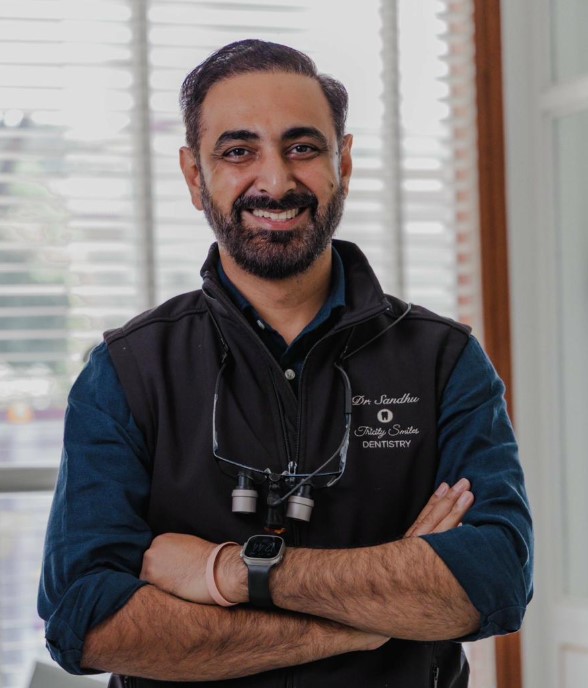
Dr. Sandhu
USC · UCSF · CMC Ludhiana
— Our Philosophy
Why most dentures don’t fit well — and how 3D
scanning changes that.
The most common complaint about partial dentures — that they are uncomfortable, loose, or cause sore spots — is not a function of the material alone. It is a function of fit. And fit is determined almost entirely by the accuracy of the impression taken at the start of the process.
Traditional denture impressions involve trays loaded with alginate or polyether material placed in the mouth while the patient holds still. The material distorts as it is removed from an undercut-rich mouth. It distorts further as it is handled, transported, and poured in the lab. By the time a model exists, the dimensional changes have compounded through multiple stages.
A denture is only as good as the record it was made from. A distorted impression produces a distorted denture — regardless of how well it is processed.
The 3Shape TRIOS intraoral scanner captures the full arch in a continuous digital scan that has no dimensional distortion — no removal from the mouth, no physical handling, no pouring. The model the lab receives is a precise digital replica of your mouth as it actually is, not an approximation filtered through the limitations of a physical impression.
This matters most for partial denture patients, who often have irregular remaining tooth positions, complex soft tissue contours, and undercut-prone ridges that traditional impressions struggle to capture consistently. The digital workflow gives the laboratory the best possible starting point — and that translates into a denture that fits closer to the tissue, is more stable under chewing load, and requires fewer adjustments at delivery.

3Shape TRIOS Intraoral Scanner
— FAQ
Partial denture FAQs
What is a partial denture?
How much do partial dentures cost in Chandigarh?
What is the difference between Valplast and metal framework dentures?
Why do you use 3D scanning for dentures?
How many appointments does a partial denture take?
Should I consider implants instead of a partial denture?
For Patients — Share This Link
Caring for your partial denture
- Remove the denture at night — gums need rest from the pressure
- Store in clean water or a denture soaking solution overnight
- Clean the denture with a soft denture brush after every meal — not toothpaste (too abrasive)
- Brush your remaining natural teeth and gums twice daily — every tooth
- Clean under the clasps — food and plaque accumulate there
- Toothpaste on the denture — scratches the surface and harbours bacteria
- Very hot water — can distort the denture base
- Biting very hard foods with the denture under load
- Dropping the denture — clean over a folded towel or basin of water
- Speech may feel different for the first 1–2 weeks — this resolves with adaptation
- Mild soreness at pressure points is normal — call us for an adjustment
- Fit may loosen over time as bone changes — metal dentures can be relined; return for review
Missing teeth replaced with a denture that actually fits.
Book your consultation with Dr. Sandhu. We will assess your remaining teeth, discuss your options honestly, and design a denture that is built for comfort, stability, and longevity.
5★
Google Rating
5-star
rated on Google
20+
Years Experience