
Invisalign in
Chandigarh
— Straighten Your Teeth Without Braces
Duration
22 hrs/day
6–18 months
- ★★★★★ 5-star rated on Google
- Verified reviews on Google
- Read Reviews →
— Understanding Invisalign
How Invisalign works
Invisalign is a system of custom-fabricated clear plastic aligners that move your teeth in small, controlled increments toward the planned final position. Each aligner is worn for approximately one to two weeks before progressing to the next in the series. The aligners are removable — taken out to eat, drink anything other than water, brush, and floss — but must be worn for a minimum of 22 hours per day to stay on track.
Treatment begins with a 3D intraoral scan using our 3Shape TRIOS scanner — no impression trays, no putty. The scan feeds directly into Invisalign’s ClinCheck software, which produces a precise simulation of every tooth movement from your current position to the planned result. You see the projected outcome before a single aligner is manufactured.
As a certified Invisalign provider, Dr. Sandhu plans every case individually — reviewing the ClinCheck simulation in detail, adjusting staging and tooth movement sequencing, and monitoring progress at every review appointment throughout treatment.

What Invisalign can and cannot treat
Invisalign is highly versatile — but not every alignment issue is suitable. Here is an honest overview of what each category involves.
- Mild to moderate crowding — teeth overlapping or rotated
- Spacing — gaps between teeth
- Mild to moderate overbite — upper teeth too far forward
- Underbite — lower teeth ahead of upper (mild cases)
- Crossbite — upper and lower teeth biting incorrectly
- Open bite — front teeth not meeting
- Relapse — teeth that have shifted after previous braces
- Pre-restorative alignment — moving teeth before crowns or implants
- Severe crowding requiring significant tooth movement or extractions
- Significant vertical movement or intrusion of teeth
- Skeletal discrepancies requiring jaw surgery
- Active gum disease — must be stabilised before starting aligners
- Teeth with very short clinical crowns where attachments cannot bond
- Patients who cannot commit to 22-hour daily wear
What to Expect
Your Invisalign journey, step by step
A structured, well-monitored process from first scan to final retainer.
01
Smile Scan & ClinCheck
Your 3Shape TRIOS scan is taken, along with clinical photographs. The digital model is submitted to Invisalign and your ClinCheck simulation is produced — showing your projected tooth movements, the number of aligners, and the expected duration. You review and approve the plan before a single aligner is ordered.
02
Attachments & Start
Where the ClinCheck plan indicates attachments — small tooth-coloured composite shapes bonded to specific teeth — these are placed at your start appointment. Your first set of aligners is fitted, and you receive your next several sets to take home. Aligner changes every 1–2 weeks.
03
Progress Reviews
Review appointments every 6–8 weeks check that teeth are tracking correctly against the ClinCheck plan. IPR — interproximal reduction — is performed at designated stages where planned. Attachments may be added or modified as treatment progresses. Any deviation from planned tracking is addressed promptly.
04
Refinements & Retainers
When the initial aligner series is complete, teeth are assessed against the planned final position. Refinements — additional aligner sets — are ordered where needed to finish the result precisely. At completion, attachments are removed and retainers are fitted. Retainer wear is lifelong.
What Patients Often Ask About
Four things to understand before you start
These are the aspects of Invisalign treatment that most frequently surprise patients — explained clearly before treatment begins.
Attachments
Attachments are small, tooth-coloured composite shapes bonded to specific teeth. They give the aligner something to grip, enabling more complex movements — rotations, extrusions, and controlled root torque — that a smooth aligner surface alone cannot achieve.
Not every case requires attachments. When they are needed, they are barely visible — the same colour as your tooth — and are removed without any damage to the enamel at the end of treatment. They do not hurt to place.
IPR — Interproximal Reduction
IPR involves removing a controlled, minimal amount of enamel from between specific teeth — typically 0.1–0.5mm — to create the space needed for tooth movement without widening the arch unnecessarily.
IPR is performed with fine polishing strips or precision discs and is completely painless. The amount removed is small and clinically safe. It is planned precisely within ClinCheck before treatment begins, so you know exactly which teeth are involved and when.
Wear Time — 22 Hours Per Day
Invisalign works only while the aligners are in your mouth. The minimum requirement is 22 hours per day. Aligners come out to eat, drink anything other than water, and for oral hygiene. Nothing else.
Every hour the aligners are out is time the teeth are not moving toward the planned position — and time they may be moving back. Inconsistent wear is the most common reason Invisalign cases fall behind schedule, require more refinements, or do not achieve the planned result.
Retainers — For Life
At the end of Invisalign treatment, your teeth are in a new position that your periodontal fibres have not yet fully accepted as permanent. Without retention, they will move back toward their original positions. This is biology — not a failure of the treatment.
Vivera retainers (Invisalign’s own retainer system) or bonded fixed retainers are provided at treatment completion. Nightly retainer wear is required indefinitely. Wearing retainers for one year then stopping is not sufficient — and the relapse that follows is avoidable.
— Not All Clear Aligners Are Invisalign
Why the brand and the provider both matter
The clear aligner market in India has grown significantly — and so has the number of low-cost, generic aligner brands available through clinics and even directly online. These products look similar to Invisalign but differ substantially in material quality, aligner fabrication precision, clinical planning software, and the qualification of the providers treating with them.
Invisalign aligners are fabricated from SmartTrack — a proprietary multi-layer polyurethane plastic developed specifically for tooth movement force delivery. The ClinCheck planning software models tooth movement physics in three dimensions with a precision that generic software does not replicate. And certified Invisalign providers receive ongoing clinical training from Align Technology, tiered by case volume and complexity.
At Tricity Smiles, we offer Invisalign exclusively — because it is the system with the most clinical data, the most predictable outcomes, and the materials most precisely engineered for the purpose.
— Why Tricity Smiles
Why choose Tricity Smiles for Invisalign in Chandigarh?
Certified Invisalign Provider
3Shape TRIOS Digital Scanning
You See the Result Before You Start
Dental Health Before Aesthetics
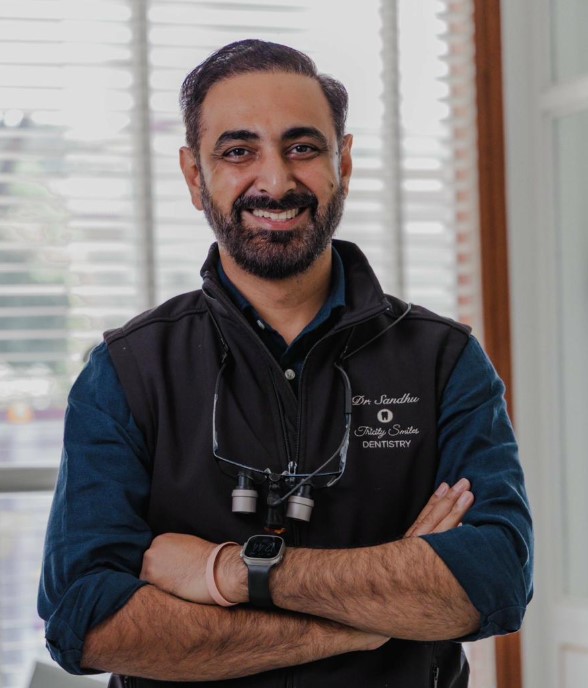
Dr. Sandhu
USC · UCSF · CMC Ludhiana
— Our Philosophy
Straight teeth are healthy teeth —why
alignment matters beyond how your smile looks.
Most patients who enquire about Invisalign are thinking about aesthetics — a more aligned smile, a straighter front row, closing a gap that has always bothered them. These are valid reasons to seek treatment. But the clinical case for correcting tooth alignment extends well beyond appearance.
Crowded, overlapping teeth are significantly harder to clean. Toothbrush bristles and floss cannot reach between teeth that are stacked against each other. Plaque accumulates in areas that cannot be accessed — and that plaque causes gum disease and cavities not in spite of good brushing but in addition to it. Patients with moderate crowding who brush diligently still accumulate interproximal plaque in areas they physically cannot reach.
Alignment is not just an aesthetic consideration. It is a long-term oral hygiene intervention.
Bite issues compound this further. Teeth that do not meet correctly distribute chewing forces unevenly — some teeth take more load than they should, accelerating wear, increasing fracture risk, and placing stress on the jaw joints over time. Crossbites cause asymmetric bone loading. Open bites change swallowing patterns. These are not cosmetic issues — they are functional ones with long-term consequences for the teeth, bone, and joints.
At Tricity Smiles, Invisalign is recommended when it will improve the health and function of the mouth — not only when it will improve the smile. When both outcomes coincide, as they often do, the case for treatment becomes compelling. When they do not — when a minor aesthetic concern does not justify the clinical intervention — we say so.
Easier to Clean
Reduced Wear
Better Jaw Function
Long-Term Tooth Preservation
— FAQ
Invisalign FAQs
How much does Invisalign cost in Chandigarh?
Invisalign at Tricity Smiles starts from ₹1,50,000. Final cost depends on the the complexity of your case. Pricing is confirmed after the ClinCheck simulation is produced, so you know the full cost before committing to treatment.
Is Invisalign suitable for me?
What are Invisalign attachments?
What is IPR in Invisalign treatment?
How long does Invisalign treatment take?
Do I need retainers after Invisalign?
For Patients — Share This Link
Invisalign during treatment tips
- Wear aligners for a minimum of 22 hours every day — no exceptions
- Brush teeth before reinserting aligners after every meal
- Rinse aligners with cold water — never hot (distorts the plastic)
- Use aligner chewies when fitting each new set — seats the aligner fully onto teeth
- Keep previous aligner sets — in case a current set is lost
- Drinking anything other than water with aligners in
- Eating with aligners in — even soft foods
- Cleaning aligners with toothpaste — scratches and clouds them
- Skipping ahead to the next aligner before the scheduled date
- Mild pressure and tightness for the first 2–3 days is normal — it means movement is happening
- Insert each new set at night so you sleep through the tightest period
- If an aligner feels completely wrong or is causing sharp pain, call us before continuing
Related reading: Is Invisalign right for you?
Your smile, straightened.Your teeth, healthier.
Book your complimentary smile scan with Dr. Sandhu. A 3D scan, a ClinCheck simulation showing your projected result, and an honest assessment of whether Invisalign is right for your specific case — before you commit to anything.
5★
Google Rating
5-star
rated on Google
20+
Years Experience