
Restorative Dentistry
Ceramic Inlays & Onlays
in Chandigarh
— The Conservative Alternative to a Crown
Duration
60 min
Pain Level
Minimal
Cost depends on the size and complexity of the restoration. All costs are discussed and agreed before treatment begins — no hidden charges.
- ★★★★★ 5-star rated on Google
- Verified reviews on Google
- Read Reviews →
— Understanding the Procedure
What are inlays and onlays?
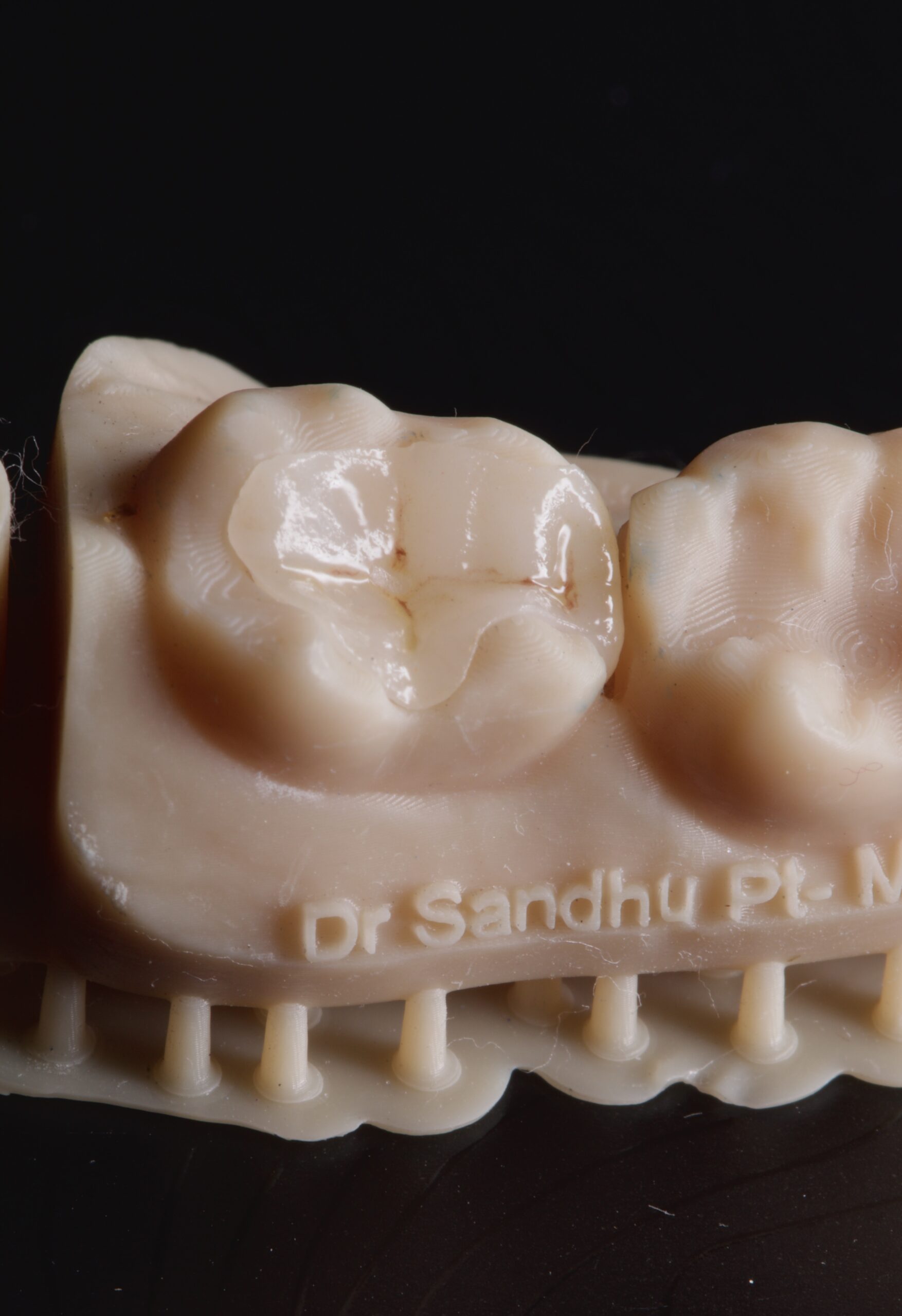
An inlay is a ceramic restoration that fits precisely within the cusps of a posterior tooth — replacing a large area of missing or decayed tooth structure at the centre of the biting surface. An onlay extends further, covering one or more of the outer cusps as well. Both are fabricated outside the mouth under controlled lab conditions and bonded in place with a precision adhesive protocol.
They occupy the space between a direct composite filling and a full crown. When a tooth has lost too much structure for a filling to hold reliably, but still has enough healthy enamel and dentine that a crown would be unnecessarily destructive, an inlay or onlay is the correct restorative choice. It preserves what is healthy, restores what is not, and does so with a material that is stronger and more durable than anything placed directly in the mouth.
At Tricity Smiles, Dr. Sandhu assesses every damaged posterior tooth against these three options before recommending treatment — choosing the restoration that is most appropriate for the tooth, not the one that is easiest to perform.
Filling vs. Inlay/Onlay vs. Crown
Which restoration is right for your tooth?
Filling
Onlay
Onlay
What to expect during your appointment
A 60-minute preparation appointment followed by a fit and bond appointment when your restoration returns from the lab.
01
Precision Preparation
Under local anaesthesia, the damaged tooth structure is removed with an electric handpiece and high-magnification loupes. The preparation is designed to be as conservative as possible — removing only what is unsound, preserving every micron of healthy tooth.
02
3D Scan & Shade
A 3D intraoral scan captures the prepared tooth, the adjacent teeth, and the bite with precision — replacing the discomfort of traditional impressions entirely. Clinical photographs are taken for shade matching before and after preparation.
03
Lab Fabrication
The digital scan is transmitted to a top-tier dental lab in India. An Emax (lithium disilicate) inlay or onlay is milled and characterised to match your tooth precisely. A temporary restoration protects the prepared tooth while the lab works.
04
Try-In & Bond
The restoration is tried in, contact points checked, bite verified, and margins inspected under magnification. Once approved, it is adhesively bonded using the correct protocol for Emax. Post-insertion photographs and a flossability check confirm everything is right.
— The Material
Why Emax for inlays and onlays?
Emax (lithium disilicate) is the material of choice for ceramic inlays and onlays because no other single material combines its strength, optical properties, and adhesive potential in one restoration. It is not simply a preference — it is the clinical standard for indirect ceramic posterior restorations.
Exceptional Strength
Adhesive Bond Strengthens the Tooth
Natural Optical Properties
Longevity
— Why Tricity Smiles
Why inlays and onlays require a different level of skill
Preparation Demands Precision
3D Scanning for Superior Fit
Correct Bonding Protocol is Essential
US-Trained Restorative Expertise
— Our Philosophy
Precision over volume — why fewer dentists offer inlays and onlays.
An inlay or onlay takes more time, more technical skill, and more investment in equipment than the two alternatives on either side of it. A large direct composite filling is faster to place and easier to justify to a patient who just wants the problem fixed. A crown is a higher-fee procedure that is more straightforward to prepare and plan. An inlay or onlay sits in neither of these convenient positions.
It requires a preparation that demands more precision than a crown. It requires a 3D scan or impression that must be more accurate than a simple crown case because the marginal fit requirements are tighter. It requires an adhesive bonding protocol that is more involved than cementing. And it requires a dentist who is willing to have a longer conversation with a patient about why the slightly more expensive, slightly more time-consuming, less familiar option is the right one for their tooth.
We do not choose the easiest option. We choose the option that serves the tooth best — today and fifteen years from now.
At Tricity Smiles, inlays and onlays are offered because we have the training, the equipment, and the technical workflow to place them correctly. They represent what we consider the highest standard of conservative restorative dentistry — giving a damaged tooth the strongest, most tooth-preserving, longest-lasting restoration that can be placed at that stage of damage.
When a patient is told they need a crown on a tooth that still has significant healthy structure, the right question to ask is whether an onlay might be sufficient. When a large filling is recommended on a tooth whose cusps are already unsupported, the right question is whether an inlay would hold that tooth together more reliably over the next decade.
These are the questions Dr. Sandhu asks before recommending any restorative treatment. The answer is not always an inlay or onlay — but it is always the most appropriate option for the tooth as it presents at that moment.
— FAQ
Inlay & onlay FAQs
Common questions about ceramic inlays, onlays, and how they compare to fillings and crowns.
What is the difference between an inlay and an onlay?
How much do inlays and onlays cost in Chandigarh?
Are inlays and onlays better than fillings?
When is an inlay or onlay used instead of a crown?
Why is Emax used for inlays and onlays?
How long do inlays and onlays last?
After your inlay or onlay
Immediately After Bonding
- Avoid hard or sticky foods for 24 hours
- Some sensitivity to temperature is normal for a few days — especially along the margins
- If your bite feels uneven, call us — a minor occlusal adjustment is a quick fix
- Brush margins carefully twice daily — where the ceramic meets the tooth
- Floss daily — the contact point should pass floss cleanly
- Attend your regular cleaning and check-up appointments
- Avoid biting very hard objects — ice, hard candy, nutshells
- If you grind at night, a custom night guard protects your restoration significantly
The most conservative restoration your tooth deserves.
Book your consultation with Dr. Sandhu. If your tooth needs more than a filling but less than a crown, an Emax inlay or onlay may be the most intelligent restoration available — and the one that keeps your tooth intact for the longest.
5★
Google Rating
5-star
rated on Google
20+
Years Experience