
Restorative Dentistry
CAD/CAM Dental Crowns
In Chandigarh — Emax and Zirconia Crowns
Duration
60 min
Pain Level
Minimal
- ★★★★★ 5-star rated on Google
- Verified reviews on Google
- Read Reviews →
— Understanding the Procedure
When is a dental crown needed?
A dental crown is a full-coverage ceramic restoration that encases the visible portion of a tooth above the gumline. It restores the tooth’s shape, strength, and appearance when the remaining tooth structure is insufficient to support a filling alone — most commonly after significant decay, a crack, a fracture, or following root canal treatment.
Dr. Sandhu assesses each tooth individually to determine whether a crown is indicated, or whether a more conservative option — such as an inlay or onlay — would preserve more tooth structure with an equally durable result. A crown is recommended only when the clinical evidence supports it.
At Tricity Smiles, every crown is documented with pre-treatment and post-treatment photographs, a post-insertion radiograph to confirm seating, and a flossability check to ensure the contact area can be maintained hygienically. These steps are standard in the US and at Tricity Smiles — and absent in most dental clinics across India.
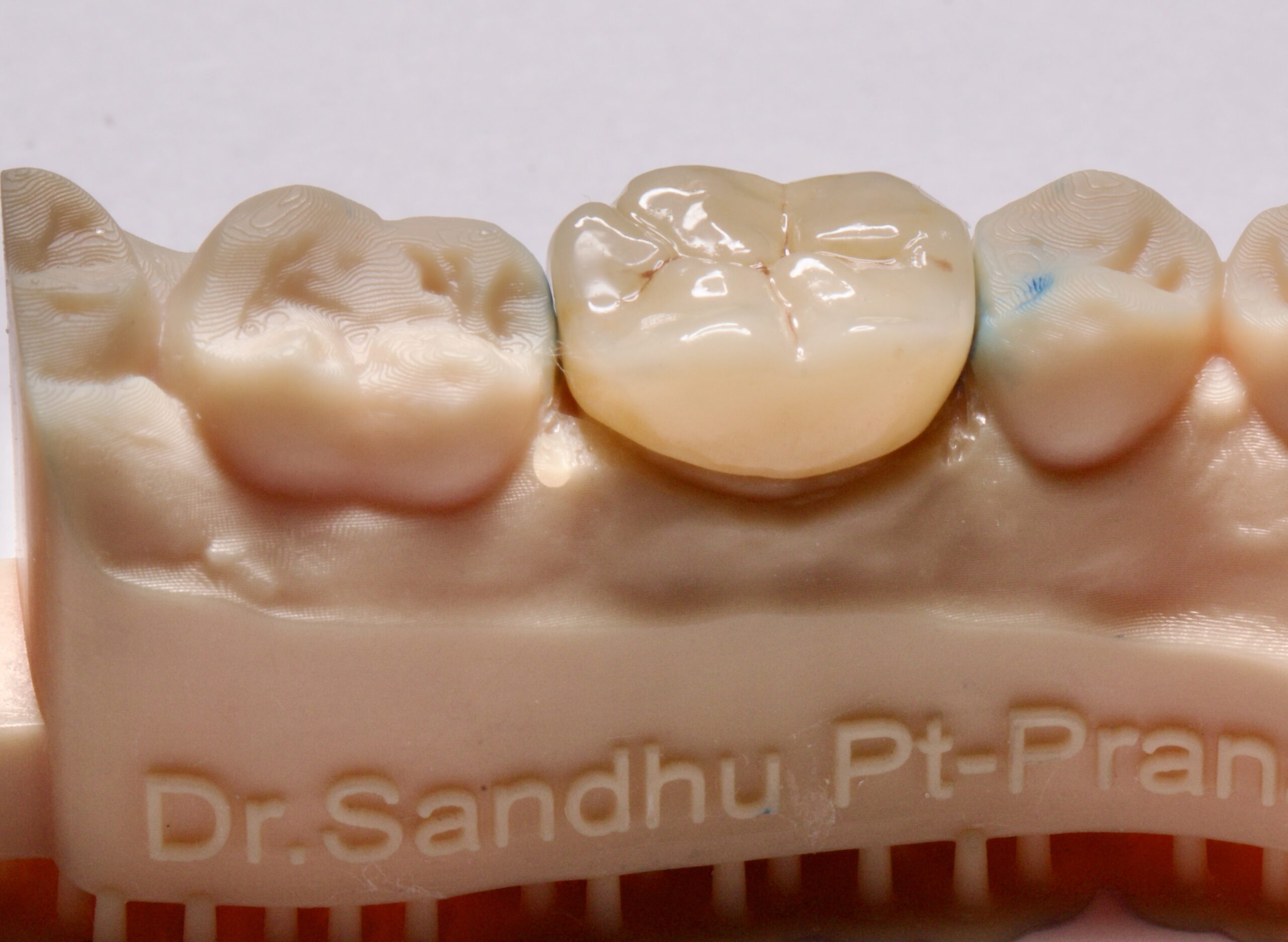
Crown Materials
Not all crowns are the same material
Three main types of dental crown exist. Here is how they compare — and which ones we offer and recommend.
| PFM Rarely Offered | Zirconia Offered | Emax (Lithium Disilicate) Offered | |
|---|---|---|---|
| Full name | Porcelain-Fused-to-Metal | Zirconia ceramic | Lithium disilicate (Emax) |
| Structure | Metal coping with porcelain overlay | Solid or multilayered zirconia block | Pressed or milled lithium disilicate ceramic |
| Strength | Good — but porcelain chips over time | Excellent — extremely fracture-resistant | Very good — strong enough for most teeth |
| Aesthetics | Acceptable — dark metal margin visible over time | Very good — especially with multilayered zirconia | Exceptional — the most lifelike translucency available |
| Best for | Legacy use — largely replaced by ceramics | Back teeth, bruxers, high-force areas | Front teeth, visible areas, high-aesthetic cases |
| Metal content | Yes — metal coping | None | None |
| Gum response | Metal can cause grey gum margin over time | Excellent gum compatibility | Excellent gum compatibility |
| Longevity | 10–15 years (porcelain chip risk) | 15–25+ years with good care | 15–20+ years with good care |
| Starting price | On request — specific indication only | From ₹15,000 | Higher — discussed at consultation |
Why the type and manufacturer of zirconia matters
Crown preparation — where most problems begin
The quality of a crown is determined as much by how the tooth is prepared as by what material is used. A poorly prepared tooth means a poorly fitting crown — regardless of how expensive the ceramic is.
01
High-Magnification Loupes
Crown preparation requires working at a level of detail invisible to the naked eye — precise margins, consistent reduction depths, smooth surfaces with no undercuts. Dr. Sandhu uses high-magnification loupes throughout preparation to identify and correct any defect in the preparation design before the scan is taken.
02
Electric Handpieces
Air-driven drills operate at variable speeds and generate heat inconsistently. Electric handpieces deliver precise, controlled cutting at consistent torque — less heat, less vibration, more tactile feedback. For crown preparation, where margins must be exact and pulp protection matters, electric handpieces are the correct tool.
03
Proper Margins
The margin is where the crown meets the tooth. An imprecise or poorly designed margin creates a gap where bacteria accumulate, leading to secondary decay beneath the crown. At Tricity Smiles, margins are placed and refined with precision instruments to ensure the crown seals completely against the tooth.
04
Shade Selection & Photography
Shade matching is done before preparation begins — when the tooth is hydrated and natural — using shade guides and calibrated clinical photographs. These photographs are sent to the lab alongside the 3D scan so the technician can match the exact colour, translucency, and characterisation of your adjacent teeth.
— 3D Intraoral Scanning
Why we scan instead of take impressions
Traditional dental impressions involve placing a tray filled with putty-like material in the patient’s mouth and holding it there while it sets. For patients with a gag reflex, or simply for anyone who finds this uncomfortable, it is one of the least pleasant parts of the dental experience. It is also one of the least accurate steps in crown fabrication.
At Tricity Smiles, we use a 3D intraoral scanner — a small handheld camera wand that captures a precise digital model of your prepared tooth, your bite, and the surrounding teeth in minutes. No material, no discomfort, no waiting for impressions to set and harden.
The digital scan is transmitted directly to the lab — instantly, with no dimensional distortion from physical handling or pouring. This is one of the most significant improvements in crown fabrication of the last decade, and it is the reason we are not limited to using local Chandigarh labs. The scan goes to whoever is the best lab for your specific case — anywhere in India.
— Lab Quality
Using the best labs in India — not just the nearest
Most dental clinics in Chandigarh send crown work to local labs — because convenience and established relationships make this the easiest choice. The quality of the local lab rarely comes into the conversation.
At Tricity Smiles, our 3D digital workflow means we are not geographically constrained. Each crown case is sent to the most appropriate lab based on the clinical requirements — whether that is a front tooth that requires exceptional shade characterisation and translucency, or a back tooth that demands maximum strength in high-grade zirconia.
We work with labs that use named, verified materials from leading manufacturers and can provide technical documentation for every crown fabricated. This means you know exactly what material is in your mouth — the grade of zirconia, the manufacturer, the firing protocol. This is the standard of care in the US and it is what we hold ourselves to in Chandigarh.
The philosophy is simple: a crown is a long-term investment in a tooth you want to keep for decades. The extra cost of a premium material and a top-tier lab is negligible compared to the cost of a crown that fails and needs replacing — with all the additional tooth reduction, time, and expense that entails.
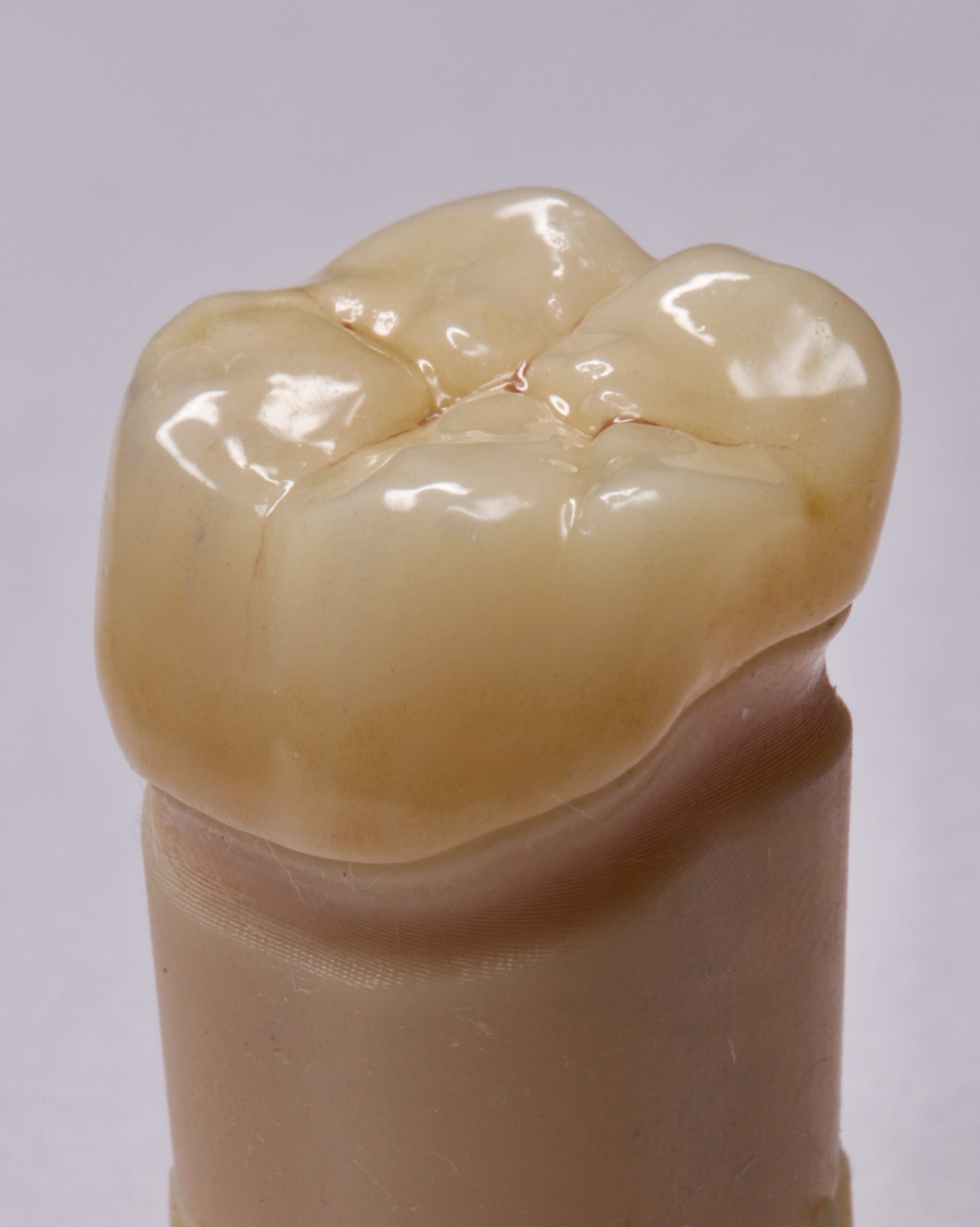
Two practices that damage more than they help
These are common across dental clinics in India. They are presented as routine — but they are not evidence-based, and they cost patients more than they save.
Not Evidence-Based
Routine root canals before crowning
In many dental clinics across India, a root canal treatment is performed on every tooth before a crown is placed — as a blanket policy rather than a clinical decision. The reasoning sometimes given is that it prevents sensitivity or future problems under the crown.
Root canal treatment is only indicated when there is clinical or radiographic evidence of pulp pathology. Not as a precaution before crowning.
Performing root canal treatment on a tooth with a healthy, vital pulp devitalises the tooth unnecessarily. A devitalised tooth becomes more brittle over time, is more prone to fracture, and no longer has the sensory feedback that warns you when something is wrong. If the pulp is healthy, it should stay healthy — and at Tricity Smiles, we do not perform root canal treatment unless there is a clear clinical indication. Your pulp vitality is checked and documented before any decision is made.
Creates Long-Term Problems
Joining crowns together (splinting)
Splinting — joining two or more adjacent crowns into a single unit — is a common practice in India, sometimes done to simplify laboratory work, sometimes to fill the space of a missing tooth as part of a bridge, and sometimes with no clear clinical rationale at all.
Adjacent crowns should be individual restorations unless a bridge is specifically required to replace a missing tooth.
— Our Philosophy
What to ask your dentist before saying yes to a crown.
A dental crown is one of the most significant restorations in dentistry. It involves reducing a real tooth, committing to a specific material, and trusting a specific lab and a specific dentist to execute it correctly. Before you proceed, these are the questions every patient should ask — and the answers you should be getting.
Do you use magnification loupes?
Do you use electric or air-driven handpieces?
Do you take photographs and match the shade precisely?
Do you take a 3D scan or a traditional impression?
Which lab fabricates your crowns, and what material will be used?
Will the crown be cemented or bonded, and why?
Will you take before and after photos of the final crown?
Will you take an X-ray to confirm the crown is seated properly?
Can I floss around the crown after insertion?
A crown done right is protection that lasts. It is a tooth that does not need to be touched again for fifteen to twenty years. It is a margin that seals, a contact that can be cleaned, a material that does not chip or stain, and a shade that matches so well your closest friends will not notice it is there.
That is what we are building when we place a crown at Tricity Smiles. And that is why we pay attention to every detail on that list, every single time.
— FAQ
Dental crown FAQs
Common questions about zirconia crowns, Emax crowns, crown preparation, and what to expect in Chandigarh.
How much does a dental crown cost in Chandigarh?
Zirconia crowns at Tricity Smiles start from ₹15,000. Emax crowns are priced higher and discussed at consultation depending on clinical indication. PFM crowns are available in specific clinical situations only. All costs are discussed and agreed before treatment begins — no hidden charges.
What is the difference between zirconia and Emax crowns?
Do I need a root canal before getting a crown?
Why does the quality of zirconia matter?
Why do you use 3D scanning instead of impressions?
Should crowns on adjacent teeth be joined together?
For Patients — Share This Link
After your crown is placed
- Avoid hard or sticky foods for 24 hours
- Some sensitivity to temperature is normal for a few days
- If the bite feels high, call us — a minor adjustment resolves this quickly
- Brush along the crown margin (where the crown meets the gum) twice daily
- Floss daily — pass the floss through the contact and curve it around the crown
- Attend your regular cleaning and check-up appointments
- Avoid biting very hard objects — ice, hard candy, nutshells
- Avoid grinding or clenching — ask about a night guard if indicated
- Crown feels loose or movement is felt when biting
- Sensitivity that worsens rather than settles over 2 weeks
- Pain when biting down
Related reading: Types of dental crowns · Zirconia crowns explained · E-Max crowns explained
Protection that lasts.
Book your crown consultation with Dr. Sandhu. Premium materials, precision preparation, and a standard of care that gives you a crown built to last for decades.
5★
Google Rating
5-star
rated on Google
20+
Years Experience